GameOfLife
Problem
https://leetcode.com/problems/game-of-life/
According to Wikipedia’s article: “The Game of Life, also known simply as Life, is a cellular automaton devised by the British mathematician John Horton Conway in 1970.”
The board is made up of an m x n grid of cells, where each cell has
an initial state: live (represented by a 1) or dead
(represented by a 0). Each cell interacts with its eight
neighbors
(horizontal, vertical, diagonal) using the following four rules (taken
from the above Wikipedia article):
Any live cell with fewer than two live neighbors dies as if caused by under-population.
Any live cell with two or three live neighbors lives on to the next generation.
Any live cell with more than three live neighbors dies, as if by over-population.
Any dead cell with exactly three live neighbors becomes a live cell, as if by reproduction.
The next state of the board is determined by applying the above rules
simultaneously to every cell in the current state of the m x n grid
board. In this process, births and deaths occur simultaneously.
Given the current state of the board, update the board to
reflect its next state.
Note that you do not need to return anything.
Example 1:
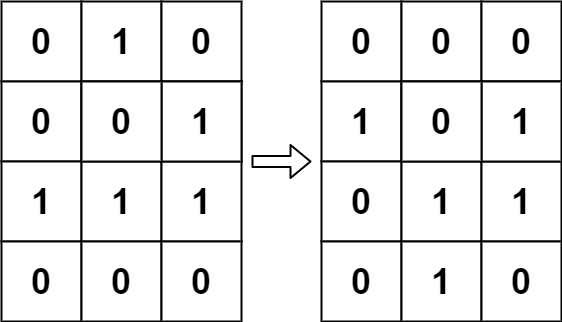
Input: board = [[0,1,0],[0,0,1],[1,1,1],[0,0,0]]
Output: [[0,0,0],[1,0,1],[0,1,1],[0,1,0]]
Example 2:
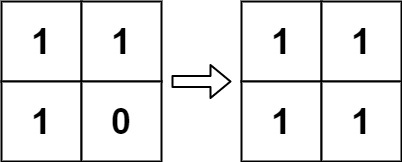
Input: board = [[1,1],[1,0]]
Output: [[1,1],[1,1]]
Constraints:
m == board.lengthn == board[i].length1 <= m, n <= 25board[i][j]is0or1.
Follow up:
Could you solve it in-place? Remember that the board needs to be updated simultaneously: You cannot update some cells first and then use their updated values to update other cells.
In this question, we represent the board using a 2D array. In principle, the board is infinite, which would cause problems when the active area encroaches upon the border of the array (i.e., live cells reach the border). How would you address these problems?
Solution
Observe that we can calulate the number of live neighbors by summing the surrounding \(\mathtt{board[i'][j']}\) values. Use a list comprehension to get the neighbor indices, only taking those where \(0 \leq i' < m\) and \(0 \leq j < n\). Make sure to calculate the number of live neighbors for each cell before updating the board.
Pattern
Array, Matrix, Simulation
Code
from typing import List


def gameOfLife(board: List[List[int]]) -> None:
    """Advance the board for Conway's Game of Life by one step.

    Do not return anything, modify board in-place instead.
    """
    m = len(board)
    n = len(board[0])

    num_live_neighbors = []

    for i, row in enumerate(board):
        num_live_neighbors_row = []
        for j, cell in enumerate(row):
            neighbor_indices = [
                (i - 1, j - 1),
                (i - 1, j),
                (i - 1, j + 1),
                (i, j - 1),
                (i, j + 1),
                (i + 1, j - 1),
                (i + 1, j),
                (i + 1, j + 1)
            ]
            neighbors = [
                board[i_][j_]
                for i_, j_ in neighbor_indices
                if 0 <= i_ < m and 0 <= j_ < n
            ]
            num_live_neighbors_row.append(sum(neighbors))
        num_live_neighbors.append(num_live_neighbors_row)

    for i, row in enumerate(board):
        for j, cell in enumerate(row):
            if cell == 0:
                if num_live_neighbors[i][j] == 3:
                    board[i][j] = 1
            else:
                if num_live_neighbors[i][j] < 2:
                    board[i][j] = 0
                elif num_live_neighbors[i][j] < 4:
                    board[i][j] = 1
                else:
                    board[i][j] = 0
Test
>>> from GameOfLife import gameOfLife
>>> board = [[0, 1, 0], [0, 0, 1], [1, 1, 1], [0, 0, 0]]
>>> gameOfLife(board)
>>> board
[[0, 0, 0], [1, 0, 1], [0, 1, 1], [0, 1, 0]]
>>> board = [[1, 1], [1, 0]]
>>> gameOfLife(board)
>>> board
[[1, 1], [1, 1]]
- GameOfLife.gameOfLife(board: List[List[int]]) None
Advance the board for Conway’s Game of Life by one step.
Do not return anything, modify board in-place instead.