AddTwoNumbers
Problem
https://leetcode.com/problems/add-two-numbers/
You are given two non-empty linked lists representing two non-negative integers. The digits are stored in reverse order, and each of their nodes contains a single digit. Add the two numbers and return the sum as a linked list.
You may assume the two numbers do not contain any leading zero, except the number 0 itself.
Example 1:
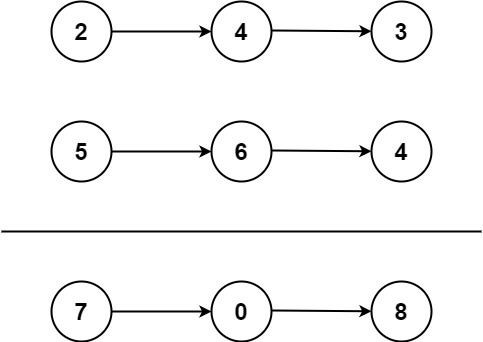
Input: l1 = [2,4,3], l2 = [5,6,4]
Output: [7,0,8]
Explanation: 342 + 465 = 807.
Example 2:
Input: l1 = [0], l2 = [0]
Output: [0]
Example 3:
Input: l1 = [9,9,9,9,9,9,9], l2 = [9,9,9,9]
Output: [8,9,9,9,0,0,0,1]
Constraints:
The number of nodes in each linked list is in the range
[1, 100].0 <= Node.val <= 9It is guaranteed that the list represents a number that does not have leading zeros.
Solution
When adding 2 numbers l1 and l2, the addition stops only when we run
out of nodes in l1 and l2 and the carry is empty. We get the next digit
using modulus and the carry using division.
s = l1.val + l2.val + carry
digit = s % 10
carry = s // 10
If head is not set, set head = ListNode(digit) and node = head.
Otherwise, set the next node node.next = ListNode(digit) and advance the
node pointer.
Pattern
Linked List, Math, Recursion
Code
from __future__ import annotations


class ListNode:
    """Node in a linked list.
    """

    def __init__(self, val: int, next: ListNode | None = None):
        self.val = val
        self.next = next

    def to_list(self):
        list = []
        while self is not None:
            list.append(self.val)
            self = self.next
        return list

    @classmethod
    def from_list(cls, list: ListNode[int]) -> ListNode | None:
        head: ListNode | None = None
        for el in list:
            if head is None:
                head = ListNode(el)
                node = head
            else:
                node.next = ListNode(el)
                node = node.next
        return head


def addTwoNumbers(l1: ListNode | None, l2: ListNode | None):
    """Add two numbers whose digits are stored in little endian linked lists.
    """
    head = None

    carry = 0
    while not (l1 is None and l2 is None and carry == 0):
        if l1 is not None:
            val1 = l1.val
            l1 = l1.next
        else:
            val1 = 0

        if l2 is not None:
            val2 = l2.val
            l2 = l2.next
        else:
            val2 = 0

        s = carry + val1 + val2
        digit = s % 10
        carry = s // 10

        if head is None:
            head = ListNode(digit, None)
            node = head
        else:
            node.next = ListNode(digit, None)
            node = node.next

    return head
Test
>>> from AddTwoNumbers import addTwoNumbers, ListNode
>>> l1 = ListNode.from_list([2, 4, 3])
>>> l2 = ListNode.from_list([5, 6, 4])
>>> addTwoNumbers(l1, l2).to_list()
[7, 0, 8]
>>> l1 = ListNode.from_list([0])
>>> l2 = ListNode.from_list([0])
>>> addTwoNumbers(l1, l2).to_list()
[0]
>>> l1 = ListNode.from_list([9, 9, 9, 9, 9, 9, 9])
>>> l2 = ListNode.from_list([9, 9, 9, 9])
>>> addTwoNumbers(l1, l2).to_list()
[8, 9, 9, 9, 0, 0, 0, 1]