Set Matrix Zeroes
Problem
https://leetcode.com/problems/set-matrix-zeroes/
Given an m x n integer matrix matrix, if an element is 0,
set its entire row and column to 0’s.
You must do it in place.
Example 1:
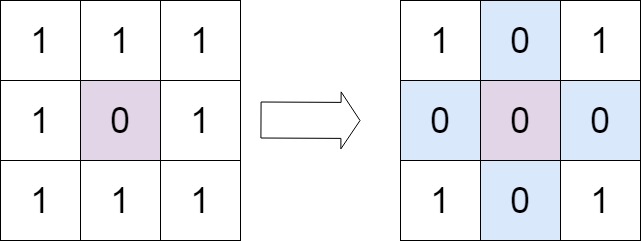
Input: matrix = [[1,1,1],[1,0,1],[1,1,1]]
Output: [[1,0,1],[0,0,0],[1,0,1]]
Example 2:
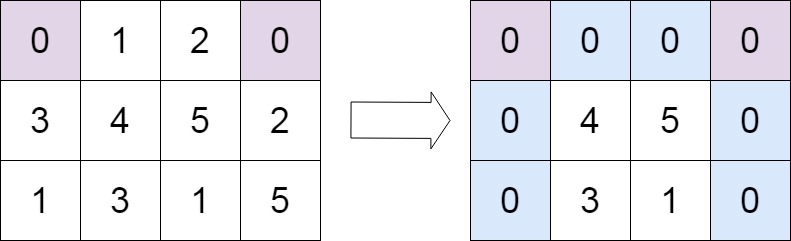
Input: matrix = [[0,1,2,0],[3,4,5,2],[1,3,1,5]]
Output: [[0,0,0,0],[0,4,5,0],[0,3,1,0]]
Constraints:
m == matrix.lengthn == matrix[0].length1 <= m, n <= 200-2:sup:`31`<= matrix[i][j] <= 2:sup:`31`- 1
Follow up:
A straightforward solution using
O(mn)space is probably a bad idea.A simple improvement uses
O(m + n)space, but still not the best solution.Could you devise a constant space solution?
Pattern
Array, Hash Table, Matrix
Approaches
Explanation
We make 2 passes over matrix. In the first pass, we find all the indices
where matrix[i][j] == 0 and store them in a list. In the second pass, we
zero all the rows and columns in the list of indices. We can make a small
optimization to convert the indices to a seet to avoid setting a row or column
to zero twice.
Code
def setZeroes(matrix: list[list[int]]) -> None:
    """Set rows and columns to zero if an element is zero.

    Do not return anything, modify matrix in-place instead.
    """
    m = len(matrix)
    n = len(matrix[0])

    indices = []

    for i in range(m):
        for j in range(n):
            if matrix[i][j] == 0:
                indices.append((i, j))

    if len(indices) == 0:
        return

    rows_to_zero, columns_to_zero = zip(*indices)
    rows_to_zero = set(rows_to_zero)
    columns_to_zero = set(columns_to_zero)

    for i in rows_to_zero:
        for j in range(n):
            matrix[i][j] = 0

    for j in columns_to_zero:
        for i in range(m):
            matrix[i][j] = 0
Test
>>> from set_matrix_zeroes__in_place import setZeroes
>>> matrix = [[1, 1, 1], [1, 0, 1], [1, 1, 1]]
>>> setZeroes(matrix)
>>> matrix
[[1, 0, 1], [0, 0, 0], [1, 0, 1]]
>>> matrix = [[0, 1, 2, 0], [3, 4, 5, 2], [1, 3, 1, 5]]
>>> setZeroes(matrix)
>>> matrix
[[0, 0, 0, 0], [0, 4, 5, 0], [0, 3, 1, 0]]
Complexity
\(m\) is the number of rows and \(n\) is the number of columns in the input matrix
Measure |
Complexity |
Notes |
|---|---|---|
Time |
\(O(m n)\) |
pass through matrix twice |
Auxiliary Space |
\(O(m n)\) |
indices of zeros which is \(m n\) in the worst case when all elements are zero |
- set_matrix_zeroes__in_place.setZeroes(matrix: list[list[int]]) None
Set rows and columns to zero if an element is zero.
Do not return anything, modify matrix in-place instead.