Pascals Triangle
Problem
https://leetcode.com/problems/pascals-triangle/
Given an integer numRows, return the first numRows of Pascal’s
triangle.
In Pascal’s triangle, each number is the sum of the two numbers directly above it as shown:
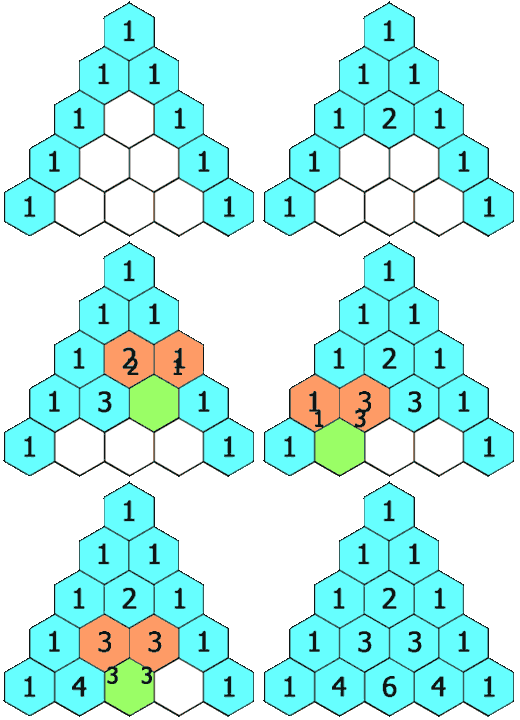
Example 1:
Input: numRows = 5
Output: [[1],[1,1],[1,2,1],[1,3,3,1],[1,4,6,4,1]]
Example 2:
Input: numRows = 1
Output: [[1]]
Constraints:
1 <= numRows <= 30
Pattern
Array, Dynamic Programming
Approaches
Explanation
Right align the normal presentation of Pascal’s Triangle.
    1        1
   1 1       1 1
  1 2 1  --> 1 2 1
 1 3 3 1     1 3 3 1
1 4 6 4 1    1 4 6 4 1
Observe that a middle entry is the sum of the entry directly above and to the north-west. The first/last entry is always 1.
Code
def generate(n_rows: int) -> list[list[int]]:
    """Generate Pascal's Triangle with ``n_rows``."""
    rows = [[1]]
    for i in range(1, n_rows):
        row = []
        for j in range(i + 1):
            if j == 0 or j == i:
                row.append(1)
            else:
                row.append(rows[i - 1][j - 1] + rows[i - 1][j])
        rows.append(row)
    return rows
Test
>>> from pascals_triangle__iterative import generate
>>> generate(3)
[[1], [1, 1], [1, 2, 1]]
>>> generate(6)
[[1], [1, 1], [1, 2, 1], [1, 3, 3, 1], [1, 4, 6, 4, 1], [1, 5, 10, 10, 5, 1]]
Complexity
\(n\) is the number of rows in the triangle
Measure |
Complexity |
Notes |
|---|---|---|
Time |
\(O(n^2)\) |
triangle is half of a square of side \(n\) |
Auxiliary Space |
\(O(1)\) |
- pascals_triangle__iterative.generate(n_rows: int) list[list[int]]
Generate Pascal’s Triangle with
n_rows.