Min Cost to Connect All Points
Problem
https://leetcode.com/problems/min-cost-to-connect-all-points/
You are given an array points representing integer coordinates of
some points on a 2D-plane, where
points[i] = [x:sub:`i`, y:sub:`i`].
The cost of connecting two points
[x:sub:`i`, y:sub:`i`] and
[x:sub:`j`, y:sub:`j`] is the manhattan
distance between them:
|x:sub:`i`- x:sub:`j`| + |y:sub:`i`- y:sub:`j`|,
where |val| denotes the absolute value of val.
Return the minimum cost to make all points connected. All points are connected if there is exactly one simple path between any two points.
Example 1:
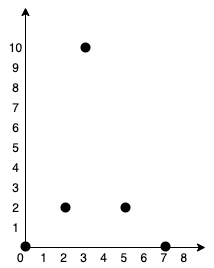
Input: points = [[0,0],[2,2],[3,10],[5,2],[7,0]]
Output: 20
Explanation:

We can connect the points as shown above to get the minimum cost of 20.
Notice that there is a unique path between every pair of points.
Example 2:
Input: points = [[3,12],[-2,5],[-4,1]]
Output: 18
Constraints:
1 <= points.length <= 1000-10:sup:`6`<= x:sub:`i`, y:sub:`i`<= 10:sup:`6`All pairs
(x:sub:`i`, y:sub:`i`)are distinct.
Pattern
Array, Union-Find, Graph Theory, Minimum Spanning Tree
Approaches
Explanation
We can use Prim’s algorithm to find the minimum spanning tree of the graph
formed by the points. We start with an arbitrary point p = points[0]
and initialize a min-heap of edges from p to all other points. We then
repeatedly extract the minimum edge from the heap, add it to the MST, and
add all edges from the newly added point to the heap. If the minimum edge
connects two points that are already in the MST, we discard it and proceed
with the next minimum edge. We continue this process until we have added
all points to the MST.
Code
import heapq


def dist(p, q):
    """Returns the L1 distance between 2D points ``p`` and ``q``."""
    return abs(p[0] - q[0]) + abs(p[1] - q[1])


def minCostConnectPoints(points: list[list[int]]) -> int:
    """Returns the minimum cost to connect all points where the cost to connect
    any two points is their L1 distance.
    """
    points = [(x, y) for [x, y] in points]

    visited = set()
    p = points[0]
    visited.add(p)
    edges = [(dist(p, q), p, q) for q in points if p != q]
    heapq.heapify(edges)

    total_cost = 0
    while len(visited) < len(points):
        cost, p, q = heapq.heappop(edges)
        if q in visited:
            continue

        visited.add(q)

        total_cost += cost

        for r in points:
            if r not in visited:
                heapq.heappush(edges, (dist(q, r), q, r))

    return total_cost
Test
>>> from min_cost_to_connect_all_points__prims_algorithm import minCostConnectPoints
>>> minCostConnectPoints([[0,0],[2,2],[3,10],[5,2],[7,0]])
20
>>> minCostConnectPoints([[3,12],[-2,5],[-4,1]])
18
Complexity
Measure |
Complexity |
Notes |
|---|---|---|
Time |
\(O(n^2 \log n)\) |
Prim’s algorithm is \(P(E log V)\) where, here, we have \(n^2\) possible “edges” and \(n\) nodes |
Auxiliary Space |
\(O(n^2)\) |
min heap of edges |
- min_cost_to_connect_all_points__prims_algorithm.dist(p, q)
Returns the L1 distance between 2D points
pandq.
- min_cost_to_connect_all_points__prims_algorithm.minCostConnectPoints(points: list[list[int]]) int
Returns the minimum cost to connect all points where the cost to connect any two points is their L1 distance.