Diameter of Binary Tree
Problem
https://leetcode.com/problems/diameter-of-binary-tree/
Given the root of a binary tree, return the length of the
diameter of the tree.
The diameter of a binary tree is the length of the longest path
between any two nodes in a tree. This path may or may not pass through
the root.
The length of a path between two nodes is represented by the number of edges between them.
Example 1:
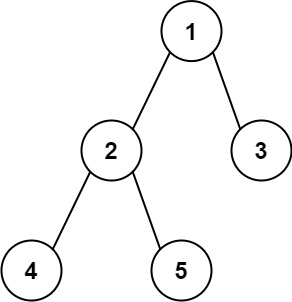
Input: root = [1,2,3,4,5]
Output: 3
Explanation: 3 is the length of the path [4,2,1,3] or [5,2,1,3].
Example 2:
Input: root = [1,2]
Output: 1
Constraints:
The number of nodes in the tree is in the range
[1, 10:sup:`4`].-100 <= Node.val <= 100
Pattern
Tree, Depth-First Search, Binary Tree
Approaches
Explanation
We can use depth-first search to traverse the tree and calculate the diameter. The diameter of a tree is equal to the maximum depth of the left subtree plus the maximum depth of the right subtree. Because the diameter is the sum of the maximum depths of the left and right subtrees, our DFS function must return the maximum depth of the subtree rooted at the current node.
Thus we only need to keep track of the maximum diameter found so far and update it whenever we find a larger diameter.
Code
from __future__ import annotations

from collections import deque


class TreeNode:
    """Node in a binary tree."""

    def __init__(self, val=0, left=None, right=None):
        self.val = val
        self.left = left
        self.right = right

    @classmethod
    def from_list(cls, vals: list[int | None]) -> TreeNode | None:
        if not vals:
            return None

        root = cls(vals[0])
        queue = deque([root])
        children = iter(vals[1:])

        while queue:
            node = queue.popleft()
            for side in ("left", "right"):
                val = next(children, None)
                if val is not None:
                    child = cls(val)
                    setattr(node, side, child)
                    queue.append(child)

        return root


def diameterOfBinaryTree(root: TreeNode | None) -> int:
    """Return the diameter of the binary tree."""
    result = 0

    def dfs(node: TreeNode | None) -> int:
        nonlocal result

        if node is None:
            return 0

        left = dfs(node.left)
        right = dfs(node.right)
        result = max(result, left + right)
        return 1 + max(left, right)

    dfs(root)
    return result
Test
>>> from diameter_of_binary_tree__dfs import TreeNode, diameterOfBinaryTree
>>> diameterOfBinaryTree(TreeNode.from_list([1, 2, 3, 4, 5]))
3
>>> diameterOfBinaryTree(TreeNode.from_list([1, 2]))
1
Complexity
\(n\) is the number of nodes in the tree, and \(d\) is the maximum depth of the tree
Measure |
Complexity |
Notes |
|---|---|---|
Time |
\(O(n)\) |
visit each node once |
Auxiliary Space |
\(O(d)\) |
recursive call stack |
- class diameter_of_binary_tree__dfs.TreeNode(val=0, left=None, right=None)
Bases:
objectNode in a binary tree.