Copy List With Random Pointer
Problem
https://leetcode.com/problems/copy-list-with-random-pointer/
A linked list of length n is given such that each node contains an
additional random pointer, which could point to any node in the list, or
null.
Construct a deep
copy of the
list. The deep copy should consist of exactly n brand new nodes,
where each new node has its value set to the value of its corresponding
original node. Both the next and random pointer of the new nodes
should point to new nodes in the copied list such that the pointers in
the original list and copied list represent the same list state. None
of the pointers in the new list should point to nodes in the original
list.
For example, if there are two nodes X and Y in the original
list, where X.random --> Y, then for the corresponding two nodes
x and y in the copied list, x.random --> y.
Return the head of the copied linked list.
- The linked list is represented in the input/output
as a list of
n
nodes. Each node is represented as a pair of [val, random_index]
where:
val: an integer representingNode.valrandom_index: the index of the node (range from0ton-1) that therandompointer points to, ornullif it does not point to any node.
Your code will only be given the head of the original linked
list.
Example 1:
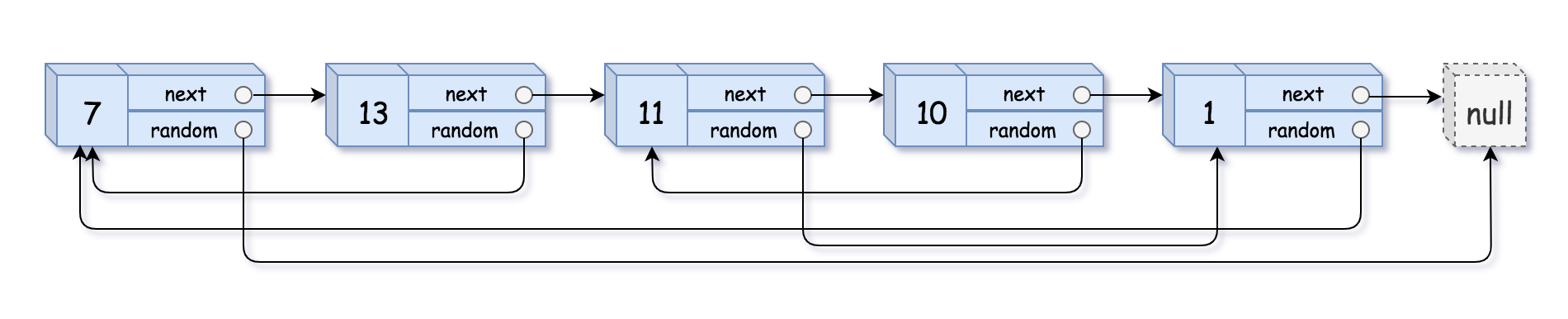
Input: head = [[7,null],[13,0],[11,4],[10,2],[1,0]]
Output: [[7,null],[13,0],[11,4],[10,2],[1,0]]
Example 2:

Input: head = [[1,1],[2,1]]
Output: [[1,1],[2,1]]
Example 3:
Input: head = [[3,null],[3,0],[3,null]]
Output: [[3,null],[3,0],[3,null]]
Constraints:
0 <= n <= 1000-10:sup:`4`<= Node.val <= 10:sup:`4`Node.randomisnullor is pointing to some node in the linked list.
Pattern
Hash Table, Linked List
Approaches
Explanation
The trick is to use a old2copy = defaultdict(Node) to map the original
node to its copy. The defaultdict creates the copy automatically if one
doesn’t exist which greatly simplifies the code. We add
old2copy[None] = None to keep pointers to None in the copy if they
were in the original.
We use a standard while node: node = node.next loop to go through all
the elements of the original linked list. For each node, we set the value
of the copied node to be the same as the original node and
copy.next = old2copy[node.next]
copy.random = old2copy[node.random]
We keep track of the head so that we can return the copy
old2copy[head] at the end.
Code
from __future__ import annotations

from collections import defaultdict


class Node:
    """Node in a linked list with a random pointer."""

    def __init__(
        self,
        x: int = 0,
        next: Node | None = None,
        random: Node | None = None,
    ):
        self.val = x
        self.next = next
        self.random = random


def copyRandomList(head: Node | None) -> Node | None:
    """Return a deep copy of the linked list with random pointers."""
    if head is None:
        return None

    old2copy = defaultdict(lambda: Node(0))
    old2copy[None] = None

    node = head
    while node:
        copy = old2copy[node]
        copy.val = node.val
        copy.next = old2copy[node.next]
        copy.random = old2copy[node.random]

        node = node.next

    return old2copy[head]
Test
>>> from copy_list_with_random_pointer__hash_map import copyRandomList, Node
>>> n1, n2, n3 = Node(7), Node(13), Node(11)
>>> n1.next, n2.next = n2, n3
>>> n2.random, n3.random = n1, n1
>>> c = copyRandomList(n1)
>>> [c.val, c.next.val, c.next.next.val]
[7, 13, 11]
>>> c is not n1
True
Complexity
\(n\) is the number of elements in the linked list
Measure |
Complexity |
Notes |
|---|---|---|
Time |
\(O(n)\) |
one pass through the linked list |
Auxiliary Space |
\(O(n)\) |
|