Binary Tree Inorder Traversal
Problem
https://leetcode.com/problems/binary-tree-inorder-traversal/
Given the root of a binary tree, return the inorder traversal of
its nodes’ values.
Example 1:
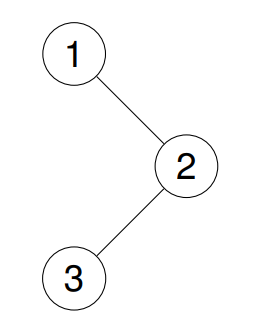
Input: root = [1,null,2,3]
Output: [1,3,2]
Explanation:
Example 2:
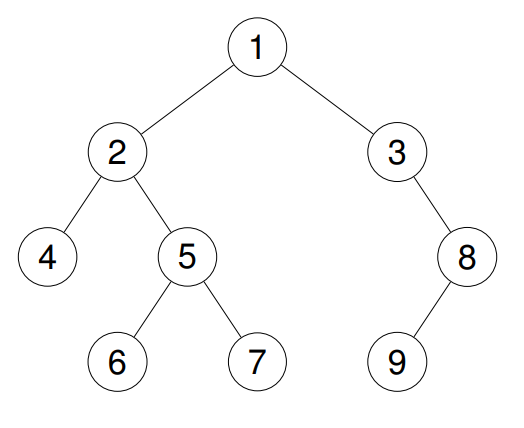
Input: root = [1,2,3,4,5,null,8,null,null,6,7,9]
Output: [4,2,6,5,7,1,3,9,8]
Explanation:
Example 3:
Input: root = []
Output: []
Example 4:
Input: root = [1]
Output: [1]
Constraints:
The number of nodes in the tree is in the range
[0, 100].-100 <= Node.val <= 100
Follow up: Recursive solution is trivial, could you do it iteratively?
Pattern
Stack, Tree, Depth-First Search, Binary Tree
Approaches
Explanation
For an inorder traversal, visit the left subtree, then the root, then the right subtree recursively.
     root (2)
    /        \\
left (1)  right (3)
Code
class TreeNode:
    """Node in a binary tree."""

    def __init__(self, val, left=None, right=None) -> None:
        self.val = val
        self.left = left
        self.right = right


def inorderTraversal(root: TreeNode | None) -> list[int]:
    """Traverse a binary tree in order from left to right."""
    if root is None:
        return []
    else:
        return (
            inorderTraversal(root.left)
            + [root.val]
            + inorderTraversal(root.right)
        )
Test
>>> from binary_tree_inorder_traversal__recursive import inorderTraversal, TreeNode
>>> root = TreeNode(1, None, TreeNode(2, TreeNode(3), None))
>>> inorderTraversal(root)
[1, 3, 2]
>>> root = None
>>> inorderTraversal(root)
[]
>>> root = TreeNode(1)
>>> inorderTraversal(root)
[1]
Complexity
\(n\) is the number of nodes in the binary tree, and \(d\) is the maximum depth of the tree
Measure |
Complexity |
Notes |
|---|---|---|
Time |
\(O(n)\) |
visit every node |
Auxiliary Space |
\(O(d)\) |
recursive call stack |
- class binary_tree_inorder_traversal__recursive.TreeNode(val, left=None, right=None)
Bases:
objectNode in a binary tree.