Balanced Binary Tree
Problem
https://leetcode.com/problems/balanced-binary-tree/
Given a binary tree, determine if it is height-balanced.
Example 1:
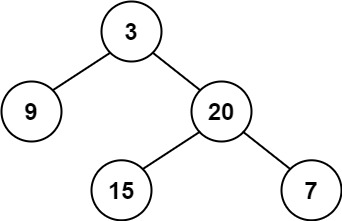
Input: root = [3,9,20,null,null,15,7]
Output: true
Example 2:
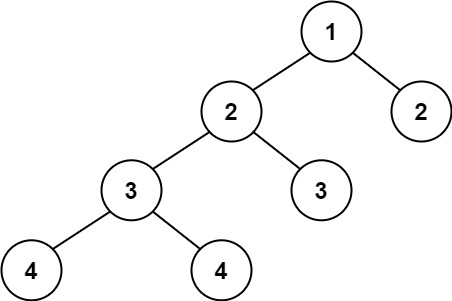
Input: root = [1,2,2,3,3,null,null,4,4]
Output: false
Example 3:
Input: root = []
Output: true
Constraints:
The number of nodes in the tree is in the range
[0, 5000].-10:sup:`4`<= Node.val <= 10:sup:`4`
Pattern
Tree, Depth-First Search, Binary Tree
Approaches
Explanation
For a binary tree to be height-balanced, the left and right subtrees of every node must differ in max height by no more than 1. We can use depth-first search to traverse the tree and calculate the max height of each tree.
If root is None, the height of a tree is 0. Otherwise, the height of
a tree is the 1 plus the maximum of the heights of the left and right
subtrees. If we encounter a subtree that is not balanced, we set a global
variable is_balanced to false.
Code
from __future__ import annotations

from collections import deque


class TreeNode:
    """Node in a binary tree."""

    def __init__(self, val=0, left=None, right=None):
        self.val = val
        self.left = left
        self.right = right

    @classmethod
    def from_list(cls, vals: list[int | None]) -> TreeNode | None:
        if not vals:
            return None

        root = cls(vals[0])
        queue = deque([root])
        children = iter(vals[1:])

        while queue:
            node = queue.popleft()
            for side in ("left", "right"):
                val = next(children, None)
                if val is not None:
                    child = cls(val)
                    setattr(node, side, child)
                    queue.append(child)

        return root


def isBalanced(root: TreeNode | None) -> bool:
    """Return whether the binary tree is height-balanced."""
    is_balanced = True

    def dfs(node: TreeNode | None) -> int:
        nonlocal is_balanced

        if node is None:
            return 0

        left = dfs(node.left)
        right = dfs(node.right)

        if abs(left - right) > 1:
            is_balanced = False

        return 1 + max(left, right)

    dfs(root)
    return is_balanced
Test
>>> from balanced_binary_tree__dfs import TreeNode, isBalanced
>>> isBalanced(TreeNode.from_list([3, 9, 20, None, None, 15, 7]))
True
>>> isBalanced(TreeNode.from_list([1, 2, 2, 3, 3, None, None, 4, 4]))
False
>>> isBalanced(TreeNode.from_list([]))
True
Complexity
\(n\) is the number of nodes in the tree, and \(d\) is the maximum depth of the tree
Measure |
Complexity |
Notes |
|---|---|---|
Time |
\(O(n)\) |
visit every node in the tree |
Auxiliary Space |
\(O(d)\) |
recursive call stack |
- class balanced_binary_tree__dfs.TreeNode(val=0, left=None, right=None)
Bases:
objectNode in a binary tree.